

Technical Support技术支持
CONTACT US
 400 179 0116
24-hour service hotline marketing@ldraft.comE-mail
Summary of Phenotypic Research on Endothelial Cells
source:QiDa technoligy views:1076 time:2026-01-21
Endothelial cells are a research hotspot in multiple disciplines. They are classified into the following five phenotypes:
1.General markers
CD31 (PECAM-1), CD34, vWF (von Willebrand Factor), and CD309 (VEGFR-2/KDR), which are commonly used for endothelial cell identification or flow cytometry screening.
2.Functional state-related phenotypes
Are categorized into quiescent, proliferative, migratory, and apoptotic types. These can be assessed through live-cell imaging and scratch assays to evaluate endothelial cells' vascular barrier function, angiogenesis, repair, remodeling, and responses to ischemia and inflammation.
3.Organ-specific phenotypes; endothelial cells in different organs possess specific markers and functions.
For example, pulmonary endothelial cells express VAP-1 and Podoplanin, primarily involved in gas exchange and low permeability. Hepatic endothelial cells express L-SIGN and CD32b, mainly associated with high permeability and immune tolerance. Cerebral endothelial cells express GLUT-1 and P-gp, forming the blood-brain barrier with high selectivity. Lymphoid tissue endothelial cells highly express MECA-79 and Podoplanin, constituting high endothelial microvessels (HEVs) that support lymphocyte homing.
4.Secondly, endothelial cells can also secrete various cytokines, chemokines, and extracellular matrix components, forming specific "secretory phenotypes":
Basal secretory phenotype: secreting fibronectin, collagen (e.g., type III, type IV), etc., to maintain vascular structure.
Inflammatory secretory type: Under stimulation by TNF-α, IL-1β, etc., it secretes IL-6, IL-8, MCP-1, GM-CSF, etc., promoting inflammatory responses.
Vascular endothelial cells (VECs): secrete VEGF, FGF2, and MMPs to promote angiogenesis.
5.Circulating endothelial cells (CECs)
Primarily refer to endothelial cells in peripheral blood, a type of progenitor cell, with the following markers: CD34⁺, CD31⁺, CD45⁻, CD133⁻, and CD309⁺. They are mainly used to assess vascular endothelial injury or regeneration status.
Recommended product: ECGM Endothelial Cell Culture Medium (Qida Biotechnology, Product Code: P1001)
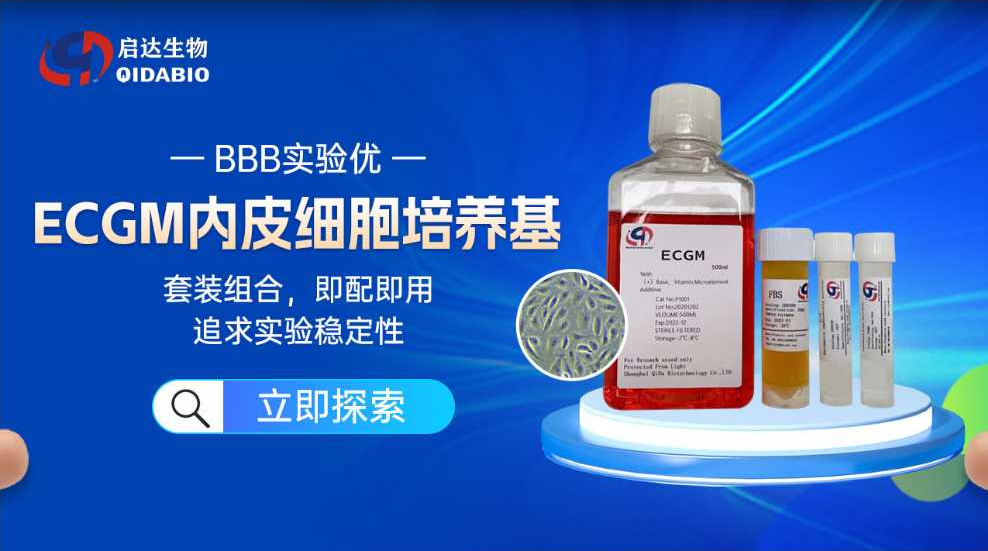
1. The preferred co-culture medium for BBB experiments, suitable for the cultivation, expansion, and passage of most vascular endothelial cells, available in mouse, rat, and human-derived variants.
2. Detailed classification into human-derived, rat-derived, and mouse-derived endothelial culture series.
3. Large-scale filtration and filling is performed with manual weighing followed by automatic weighing to ensure balanced reaction and thorough combination of all chemical components, maintaining a shelf life of one year to prevent amino acid degradation and hormone denaturation due to prolonged storage.
4. Use small-molecule compounds to inhibit heterocellular growth, and add endothelial growth factor to promote endothelial cell proliferation.
5. Growth rate verified in over 60 types of endothelial cells; can replace imported brands.
6. Low serum components reduce serum interference within cells.
7. Packaged for easy shipping, simple to prepare, and convenient to use.